

As the name suggests, employer sponsored visas enable Australian businesses to hire an overseas worker in their business on a work visa if they are unable to find a suitably skilled Australian worker. Employers who wish to access visas under this program are required to formally sponsor the employee for the visa that is suitable to their business circumstances. The Australian business can sponsor an overseas worker already in Australia (on another visa) or directly from overseas.
Similar to visas under the Skilled Migration Program, there are permanent and temporary Employer Sponsored Visas. For temporary employer sponsored visas, options are available for obtaining permanent residency upon meeting certain requirements.
Importance of Employer Sponsorship to Australia’s Migration Program
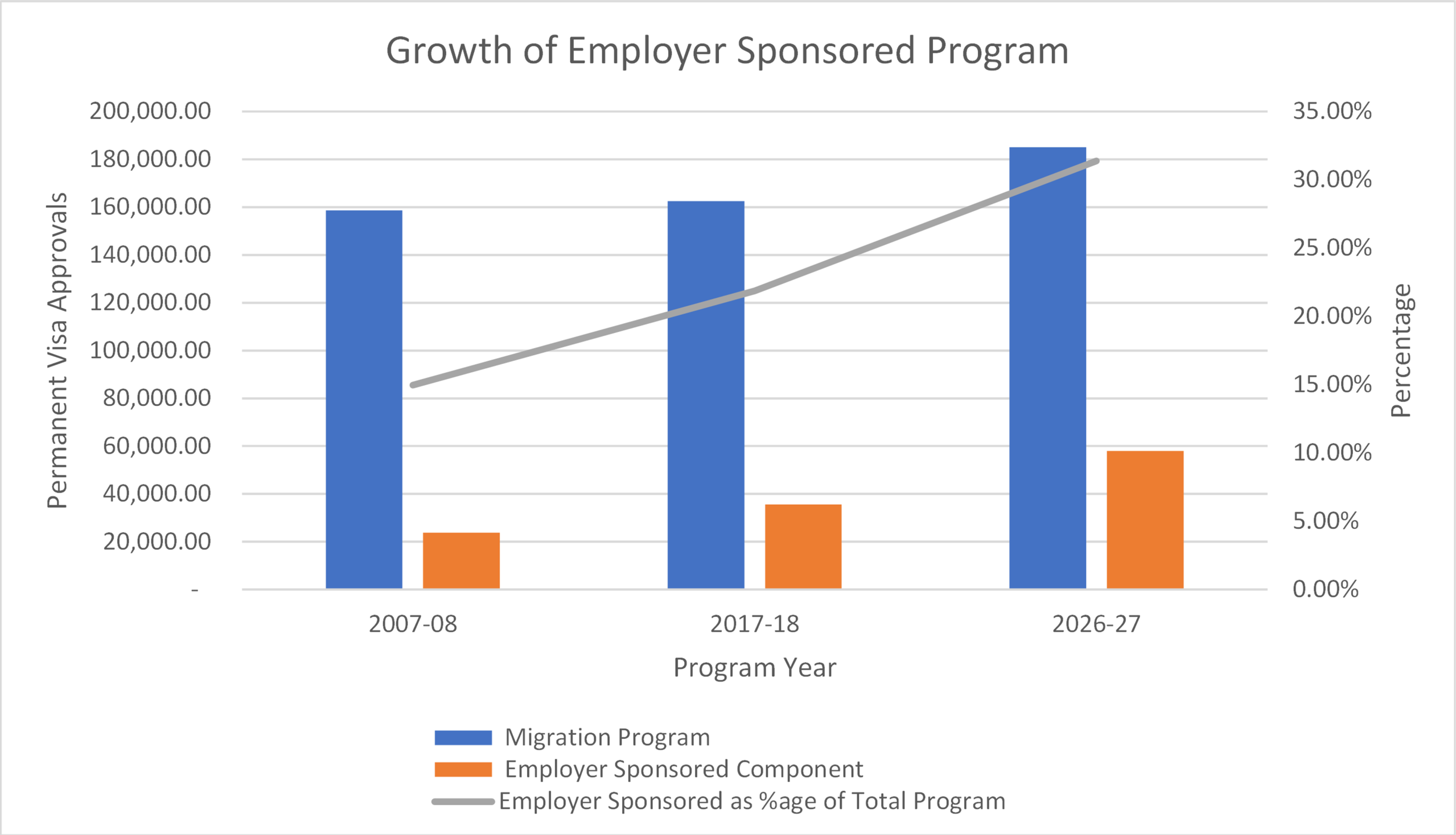
Employer Sponsored Visas have been a key element of the Australian immigration landscape for decades and in this time, undergone various transformations to keep them aligned to the needs of the Government and business. The success of this program and its uptake by Australian businesses is evident from the graph below which shows growth of this program as a percentage of the total permanent skilled migration intake.
Importantly, the numbers shown in the graph are only for ‘permanent’ employer sponsored visas and no limit is set for the temporary employer sponsored visa program which is totally demand driven. Typically, the number of temporary employer sponsored visas granted in a year tend to be almost the same as the permanent employer sponsored visas.
Difference Between Employer Sponsored and General Skilled Visas
Although the core requirements for the Employer Sponsored Visas and General Skilled Migration Visas are similar i.e. skills, English and age, both programs are unique in other respects. The table below highlights some of the key differences between these programs.
| Feature | General Skilled Migration | Employer Sponsored Program |
|---|---|---|
| Skills and experience | A formal skills assessment is required | A formal skills assessment may or may not be required depending on the visa type and stream |
| Skill Select Expression of Interest | Required | Not required |
| State/Territory nomination | Not required for visa 189. Required for visas 190 and 491 | Not required |
| Employer and job offer | Not required | Required |
| Visas for family | Can be added to visa application | Generally require approval by sponsoring business |
How Do Employer Sponsorship Visas Work?
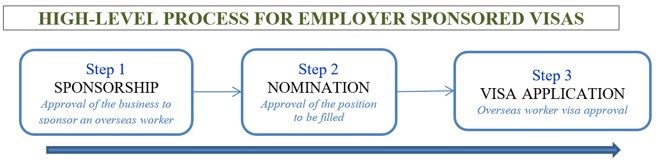
The starting point for the employer sponsored visas is the assessment of eligibility of your Australian business to sponsor an overseas worker. This process is independent of any consideration of the vacancy to be filled or the person who is to be employed, and is called Standard Business Sponsorship.
Once your business receives an SBS approval, you need to apply again to the Government to seek approval of the nominated position which is to be filled by the overseas worker. This process involves more detailed examination of the role of the position in the business, duties to be performed and must also include details of the person chosen to fill the position. This process is called Nomination. Once the Nomination is approved the overseas worker can apply for the relevant employer sponsored visa.
The complete high-level process is represented in the figure below. It is important to note that the description above and the image below show the typical process for the ‘temporary’ Employer Sponsored Visa. The process for the permanent employer sponsored visa is slightly different and explained under Employer Nomination Scheme (Subclass 186).
Need more detail on requirements?
The Assure Visa website provides you guidance on all aspects of Employer Sponsored Visas. The information is tailored to your needs whether you are an Australian business looking to hire an overseas worker or an overseas worker looking to access the Employer Sponsored Visas.
I represent an Australian business looking to hire an overseas worker
If you are looking for guidance on the operation of employer sponsored visas as an Australian business, please visit our page Employer Sponsored Visas – Guide for Business.This page and linked pages explain the requirements and various steps in details.
I am an overseas worker looking for sponsorship by an Australian business
The guidance on our page Employer Sponsored Visas – Guide for Overseas Workers would be relevant to you if you are:
a) an overseas worker currently in Australia on a different visa (Student or Temporary Graduate) and working for an Australian employer who is prepared to sponsor you for an Employer Sponsored Visa or
b) an overseas worker currently outside Australia looking for an Australian sponsor to sponsor you for an Employer Sponsored Visa.
This page and linked pages explain the requirements for the different temporary and permanent Employer Sponsored Visas.
Frequently asked questions – Employer Sponsored Visas
As your overseas worker is currently not on an employer sponsored visa, at some stage the visa they hold will expire. They may obtain permanent residence through another program or may have to return home. This creates an uncertainty for you which can be addressed through the employer sponsored visa where you decide the period for which you wish to sponsor them. If you are still unsure, you Contact Assure Visa and we can provide more clarity or discuss the pros and cons with you.
Your anxiety about pursuing a temporary visa and putting at risk, the chance to directly obtain a permanent visa is understandable. It is not possible to suggest which option you should take but you must carefully consider the risks involved such as the certainty of receiving the State nomination, any last-minute changes to occupation lists (less likely for employer sponsored visas) your current age and the time you have left for lawful stay in Australia.
Also consider whether your sponsor is likely to get their Standard Business Sponsorship and Nomination approved before you apply for the visa. If you are still unsure, you Contact Assure Visa and we assess your situation and advise you on the best course of action.