


The new world of English for Australian visas!
The Australian Government has announced changes to the English proficiency requirements, coming into effect from 7 August 2025. The changes have been introduced separately for Student Visas (500), Temporary Graduate Visas (485) and for the remaining visas for which English proficiency is a requirement.
The analysis below focuses only on the third group, that is, visas other than the student visa or the temporary graduate visa. The changes for the student or graduate visas will be covered in a separate blog. The analysis also presents the ‘before’ and ‘after’ impact for the two most commonly used English tests which are the IELTS and PTE. If you are interested to know changes to requirements for visa 500 or 485, or interested in test methods other than IELTS and PTE, reach out to us at info@assurevisa.com.au and we would be happy to help.
What are the changes?
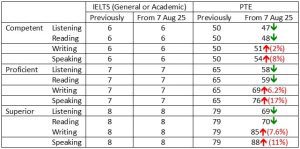
The most noticeable change is the shift away from the concept of ‘same score for each test component’ (listening, reading, writing, speaking) to prescribing a specific required score for each component. Some required scores have been raised whereas others have been lowered.
IELTS
Previously, Competent English under IELTS required a score of at least 6 in each component, for Proficient English this was 7 and for Superior English it was 8. This is the same now with the only difference being that the numbers 6, 7 and 8 are now listed against each component.
PTE
The minimum requirements for each level of proficiency (Competent, Proficient, Superior) have been changed for the PTE tests. Some have been raised while others have been lowered. The common theme is that for Listening and Reading, you can now reach the same level of proficiency with scores lower than before however, for Reading and Writing, you need to score better than before, just to reach the same level of proficiency.
Winners and losers?
Whether you are a winner or loser from these changes will depend on which test you are more inclined to take. If you are a fan of the IELTS model (general or academic) there are no changes.
However, if you prefer to take the PTE test, then the changes may be favorable if you are good in writing and speaking English but struggle with listening and reading. On the other hand, if you find difficult to score well in the writing and speaking components, you are likely to be worse off.
Why have these changes been introduced?
The Home Affairs website (link above) says, “This helps effectively manage immigration risk and ensure visa holders can fully participate in the Australian community”.
In the absence of any other details as to what risk is being referred by Home Affairs, it is our opinion from over 30 years’ experience in the field, that the risk most likely is that a certain cohort of applicants are able to get an unfair advantage by opting for the PTE test. One example could be international students who come to Australia to study vocational studies (e.g. diplomas). The nature of such studies and the pre requisite academic status (typically year 12) means that they might now struggle to meet the higher scores and therefore become less competitive for permanent visas.
The other reasoning was well articulated in the Migration Strategy that good English is key to strong workforce participation.
If you have any questions or feedback about this information, please comment below or contact us by email at info@assurevisa.com.au.
DISCLAIMER: The information above is a general opinion or analysis from Assure Visa Pty Ltd and should not be taken as immigration advice. Individuals are encouraged to consult a migration professional about their individual circumstances before making any decisions. Assure Visa does not accept liability for any consequences arising from the use of these materials.